
Water hygiene requirements in Germany: TrinkwV, VDI/DVGW 6023 and DVGW W 551
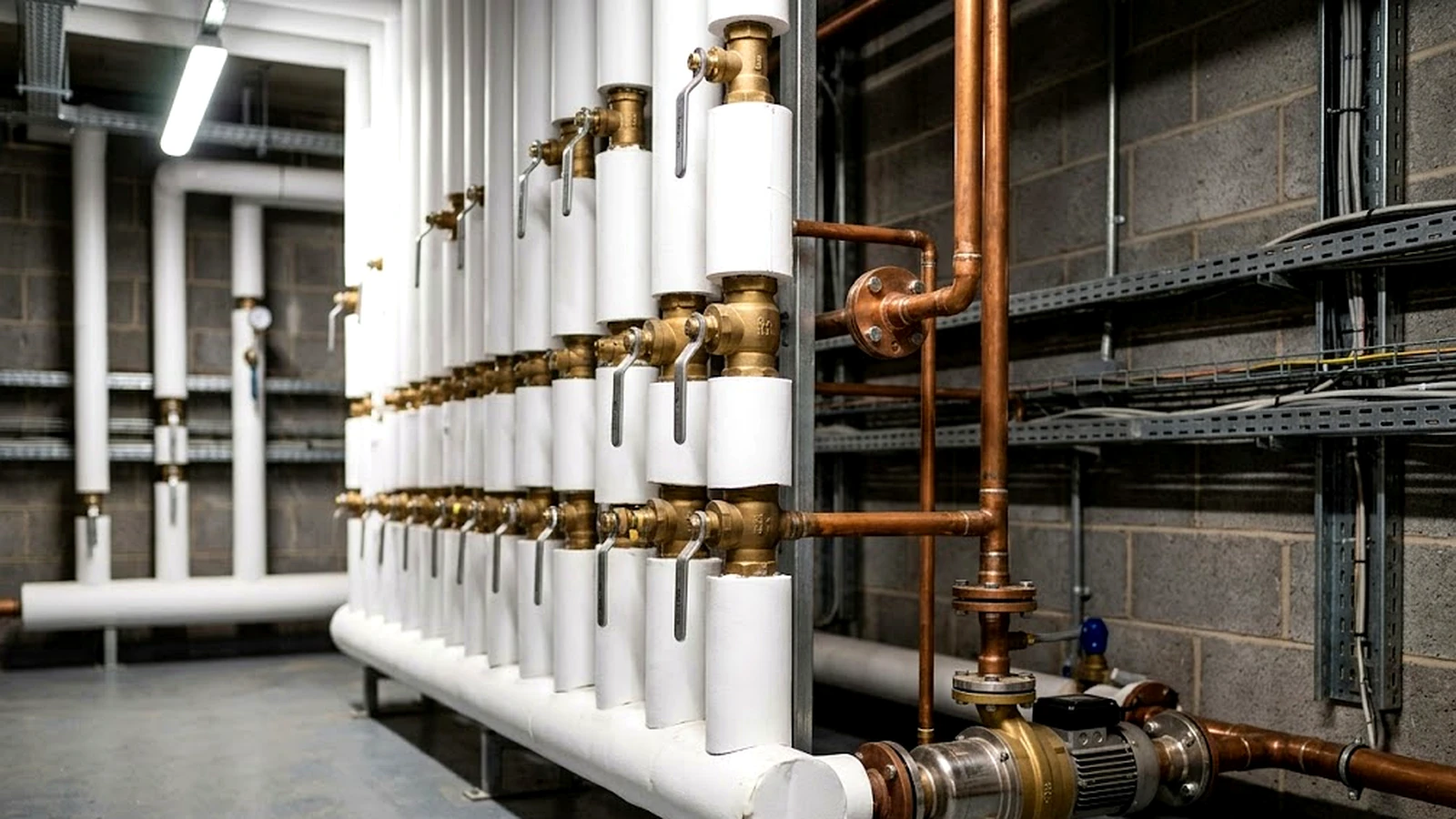
German drinking water rules place duties on the operator of a building's water system, and they are enforced through the Trinkwasserverordnung with technical practice set out in VDI/DVGW 6023 and the DVGW W 551 series. The requirement that shapes product design is the exchange of standing water: the whole content of an installation should be exchanged within 72 hours under normal conditions. For a manufacturer selling fittings or controls into Germany, that is the requirement your product has to make achievable.
- VDI/DVGW 6023
- 72hours
- Complete exchange of the installation's water, under normal conditions. Maximum seven days where demonstrated.
- W 551 temperature
- 60 / 55°C
- At the water heater outlet and in the circulation system, for the central installations W 551 covers.
- TrinkwV large installation
- over 400 l or over 3 l
- Storage volume, or pipework content between the water heater and the outlet.
In this section
Why this matters outside Germany
Germany is the largest sanitary market in Europe and its rules are among the most developed. Manufacturers in the United States, the United Kingdom, the Netherlands and elsewhere sell into it, and specifiers working on German projects have to satisfy German expectations regardless of where they are based.
The difficulty is that the material is almost entirely in German, written for German operators, and the parts that matter to a product manufacturer are not the parts a building operator reads. This page covers the German requirements from the position of someone designing or specifying equipment for that market rather than running a building in it.
One thing to establish first, because it decides everything else: these duties fall on the operator of the installation, not on the manufacturer of a fitting. A product cannot be compliant with them. What a product can do is make the operator’s compliance achievable, or make it harder.
The legal instrument: Trinkwasserverordnung
The Trinkwasserverordnung, usually abbreviated TrinkwV, is an ordinance with legal force. It obliges the operator of a water supply installation to deliver water that meets its requirements, which makes the operator responsible for hygiene throughout the building’s pipework, not merely at the point where water enters the building.
Two provisions are relevant to equipment.
Regular Legionella testing is required for large hot water installations where water is supplied in the course of a commercial or public activity, and where showers or other outlets producing an aerosol are present. Single and two-family houses are excluded. The thresholds that define a large installation come from the ordinance itself: more than 400 litres of storage, or more than 3 litres of water content in the pipework between the water heater and the outlet.
Where the technical action value for Legionella is reached or exceeded, the ordinance requires further investigation, a written risk assessment, and measures to establish the cause and remedy it.
The aerosol condition matters more than it first appears. It is why showers, not taps, drive the testing regime, and why a manufacturer of shower products faces a different regulatory environment in Germany than a manufacturer of basin taps.
The ordinance does not specify a flushing technique, a product, or a technology. It specifies an outcome and leaves the method to the operator and their designer.
The technical rules: VDI/DVGW 6023 and DVGW W 551
German practice separates law from technical rules. The ordinance sets duties; the technical rules describe how those duties are met in practice. They are part of the allgemein anerkannte Regeln der Technik, the generally recognised rules of technology, which is the standard German practitioners and courts refer to.
VDI/DVGW 6023 governs hygiene in drinking water installations, covering planning, construction, operation and maintenance. Its most consequential requirement for equipment is the definition of bestimmungsgemaesser Betrieb, intended operation.
DVGW W 551 (2004) covers technical measures against Legionella growth, and its 2004 edition is the currently valid document. W 551-2 supports risk assessment.
W 551-1 is being prepared to replace the 2004 edition. A first draft went out for comment in 2025 and a second draft was published in May 2026. The final version has not yet been published.
The former W 556 was replaced by W 551-2 in 2022, and the former W 557 by W 551-3. Anyone still citing W 556 or W 557 is working from superseded designations, which are common in English-language material.
The 72 hour requirement, stated correctly
This is the requirement most often misquoted outside Germany, and getting it right matters because the wrong version leads to the wrong product behaviour.
VDI/DVGW 6023 does not require that each outlet is used every 72 hours. It requires that the entire water content of the installation is exchanged within 72 hours under normal conditions. That is a substantially stronger requirement, because a brief draw at an outlet does not necessarily exchange the water in the branch that serves it.
The period is not absolutely fixed. Extension to a maximum of seven days is permitted where it is demonstrated that the water quality meets the ordinance and no special building requirements apply. Buildings with elevated protection needs may require shorter intervals.
The practical test used in German commissioning and maintenance is temperature constancy: flush until the temperature at the outlet stops changing, which indicates that water from the supply has reached it. On cold water that means a stable low temperature and on hot water a stable high one. British guidance uses the same test, expressed as flushing until the outlet temperature is comparable to the supply, so this is not a German peculiarity but a shared practical criterion.
What happens when a building is not used
German practice sets out a graduated response, and it is the clearest statement of the problem available in any market.
- Up to 7 days Run water at all outlets for at least five minutes, several at once so the supplying pipework reaches the required flow velocities.
- 7 days to 4 weeks Complete exchange of the water at all outlets by flushing.
- 4 weeks to 6 months Flushing followed by microbiological checks.
Hot and cold are flushed separately.
For a manufacturer, the significance is that hotels, schools, sports facilities, seasonal accommodation and partially occupied buildings all fall into these bands routinely, and the equipment installed in them either supports the regime or obstructs it. Low-use and intermittent outlets covers how those outlets are found and treated.
Temperature
For the central hot water installations covered by W 551, the temperature requirements are 60 degrees Celsius at the outlet of the water heater and at least 55 degrees in the circulation system. Smaller and decentralised installations are treated differently.
These figures are higher than delivery temperatures permitted at accessible outlets, which is the same conflict every market has: the system is deliberately hot, the outlet is deliberately not, and the tempered volume between them has to be managed. Temperature, scald protection and water hygiene at the outlet covers that conflict in detail.
What this asks of a product
Stated as design requirements rather than as compliance claims, since compliance belongs to the installation.
The reference period is 72 hours, with shorter intervals arising from risk assessment and longer ones permitted only under demonstrated conditions. A fixed interval fixed at the factory does not serve a market where the interval is an outcome of assessment.
Exchange is a function of the volume held in the branch and the flow available. A product sold across many installations cannot assume one duration.
German practice flushes them separately. A product that can only exchange through a blended path cannot demonstrate that either leg was exchanged.
The graduated bands above mean that a building’s regime changes when it empties. Equipment that can be reconfigured, or that runs a different regime during a closure, fits that reality.
A control that reports a commanded cycle evidences a command. A temperature measurement evidences the expected thermal response, which is what German practice uses as its endpoint. Only a flow measurement evidences that water passed the point of measurement. A written risk assessment is better served by a record that describes accurately what it shows.
Reading the market correctly
Two observations for manufacturers approaching Germany from outside.
The operator is the regulated party and the specifier usually knows the rules better than the supplier does. Material that overstates what a product achieves will be recognised as overstatement, and the correct posture is to describe capability precisely and leave conformity to the installation.
And the terminology carries weight. Bestimmungsgemaesser Betrieb, Stagnation, Gefaehrdungsanalyse and Risikoabschaetzung are terms of art with specific meanings, and using them loosely signals unfamiliarity. Where a document is cited, the current designation matters, since the W 551 series has been reorganised and the older references are still circulating.
Working this into a product?
Tell us the application, the environment, and the power budget. We will come back with a configuration.
Request configured samplesNeed the control electronics behind it?
Programmable switching, sensing, and firmware, developed and manufactured in-house.
Discuss your product development