
Battery-powered flushing: hygiene control where mains power does not reach
Many outlets that need automatic flushing have no mains supply, and where an electrical supply has to be added the associated work can block or delay a retrofit. A battery-powered controller removes that dependency, so a flushing control can be fitted at outlets identified as needing one without an electrical installation. Whether it lasts over a service life measured in years is a power budget question rather than a battery choice.
- The dominant term
- Standby
- In a low-duty installation, the energy drawn while idle usually exceeds everything else combined.
- Valve choice
- Latching
- Moved by a pulse, holding position with no current between pulses. It removes the largest recurring draw from the budget.
- Service life
- Calculated
- A multi-year figure is a calculated result standing on measured inputs, validated by testing.
In this section
Where mains is absent
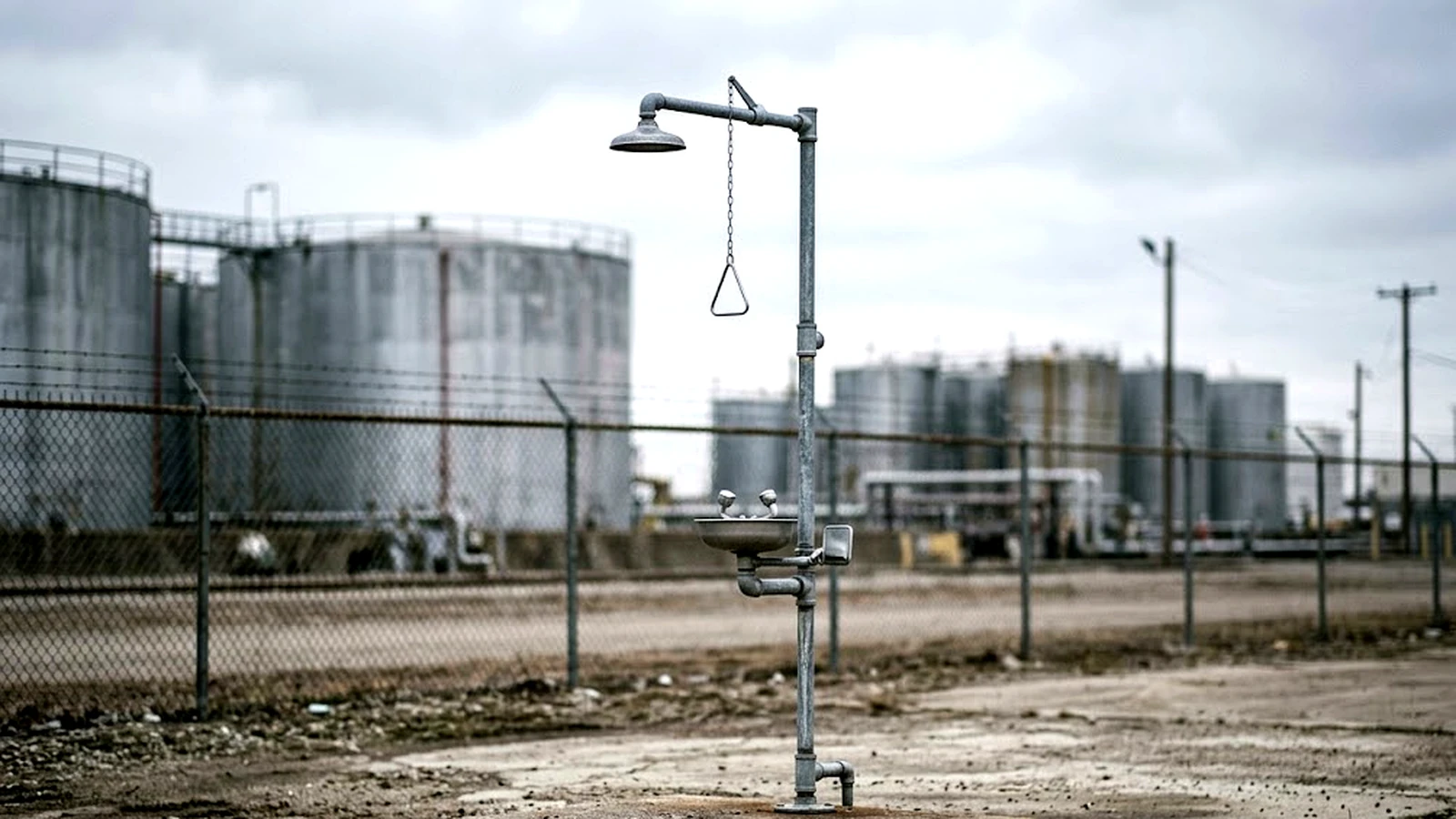
The obvious cases are outdoor and remote: emergency showers in tank farms and yards, fixtures at unmanned installations, standpipes and washing points in parks and open sites, sanitary blocks at seasonal facilities.
The less obvious cases are inside finished buildings. An outlet in a washroom that was never wired for anything, a fixture in a listed or fire-compartmented structure where new cable routes are difficult, a tap in a wing where the electrical distribution has no spare capacity, a temporary installation that has become permanent.
In new build, adding a supply to an outlet is a modest matter decided at design stage. In retrofit it is a different job: cable routes through finished walls and ceilings, containment, fire stopping, an electrician, certification, and making good afterwards. On an outdoor or remote fixture it can mean trenching and armoured cable. None of that is impossible, and all of it takes time.
Speed and disruption
The case that makes this concrete is remediation. A sample comes back adverse, or a risk assessment identifies outlets that are not being exchanged, and a flushing control has to be fitted at those outlets.
| Dimension | Mains at an outlet with no supply | Battery-powered controller |
|---|---|---|
| What the job involves | Electrical design, cable routing, containment and fire stopping, an electrician, certification, and making good afterwards. | A plumbing and fitting job. |
| What decides the saving | The building, the route and the access. | The same, and on some projects it will not be the deciding factor at all. |
| The resulting regime | The regime that was specified. | The same regime. What changes is the work needed to get to it. |
Cost, maintenance access or reporting requirements may weigh more than installation time on a given project. Where installation time does matter, this is where it goes.
The same logic applies to trials. A site that wants to establish whether automated flushing addresses its problem can fit it at a handful of outlets, observe, and extend, without committing to an electrical installation first.
What actually determines battery life
This is where specifications go wrong, because the figure that matters is not on any single datasheet.
A flush controller spends nearly all of its life waiting. In a low-duty installation, the energy drawn while idle usually exceeds everything else combined, because a small current over a very long time outweighs a larger one over the short intervals when the valve actuates. That is why standby current is the figure most worth interrogating. It is not the only contributor.
Standby current, the current drawn while awake and switching, energy per valve actuation, actuation frequency, battery self-discharge, temperature over the installed life, and design margin.
Measure the currents and the duty profile. Calculate service life from those measurements with battery capacity, self-discharge and temperature assumptions. Validate the model with long-term or accelerated testing.
Any supplier quoting a multi-year figure should be able to say what duty it assumes and how it was established.
A multi-year figure is a calculated result standing on measured inputs, not a property of the battery.
Two practical consequences. A quoted battery life at one flush per week means nothing for an outlet flushing daily. And the installed temperature has to match the temperature assumed in the service life model: a fixture in an unheated outdoor enclosure through a northern winter operates outside the conditions a bench-derived figure is likely to represent.
Valve choice decides the arithmetic
A non-latching solenoid is held open electrically for the whole time the valve is open. Every second of every flush draws current. On mains that is rarely the deciding factor. On a battery it dominates quickly.
A latching solenoid is moved by a pulse and holds position with no current between pulses. Opening takes one pulse and closing another, and between them the valve costs nothing. That is why it is the usual choice where an installation has to run for years on a battery at low duty: it removes the largest recurring draw from the energy budget. Other valve technologies and duty profiles exist, and the calculation should be done rather than assumed.
It also changes failure behaviour, which is worth thinking through rather than discovering. A latching valve holds its last commanded position. If power is lost mid-cycle, the valve stays where it was put, which means the design has to consider what happens if that position is open.
When battery is the wrong answer
Several situations, and they are worth stating plainly.
Where the outlet flushes frequently, the duty may be high enough that battery life becomes a maintenance burden rather than a convenience. Where mains is already present at the fixture, using it is simpler and removes a consumable. Where the installation needs continuous communication with a building system, holding a network interface active is difficult to reconcile with multi-year battery operation, and a wired device is the honest answer. Where access for battery replacement is genuinely hard, at height or in a secured area, the calculation should include the cost of that access and not only the cost of the cells.
And where the outlet is on emergency equipment, the battery must sit on a maintenance function rather than in the path of emergency operation, so that a depleted battery stops the flushing and not the shower.
Installing and maintaining it
The practical work is a valve in the branch, a controller, a power source, and a decision about where the flush discharges.
- Fit the valve in the branch that hydraulically serves the outlet.
- Set interval and duration from the site’s regime and the branch volume.
- Decide where the flush discharges.
- Plan battery replacement: either a monitored state of charge reported somewhere, or a scheduled interval set conservatively against the calculated life.
Working this into a product?
Tell us the application, the environment, and the power budget. We will come back with a configuration.
Request configured samplesNeed the control electronics behind it?
Programmable switching, sensing, and firmware, developed and manufactured in-house.
Discuss your product development