
Piezo keypads: how they work, how to wire them, how to choose one
A piezo keypad, also called a piezoelectric keypad, is a sealed keypad with no moving parts. Pressing a key gives a clean switching output, with nothing that travels, wears or needs a seal around it. This guide covers what that output does, how to wire and test a piezo keypad, and how to pick the right one, with values from RNC datasheets.
All models, layouts and datasheets are on the piezo keypads page.
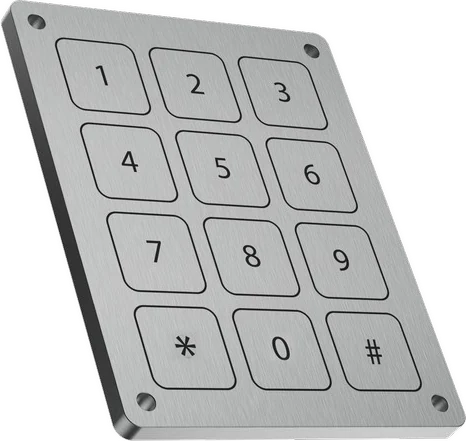
What the output does
Each key is normally open and momentary. A press closes the key's contact for a short pulse: 125 to 300 ms on the RNC PK Series, with contact bounce of 1 ms at most. It is a pulse, not a held contact, so the contact does not stay closed for as long as a finger rests on the key.
That is the one behaviour to design around: read the key on the press, not on how long it is held.
PK Series outputs: matrix as standard; common bus on the PK-20. Wiegand and RS-485 interfaces on request.
Illustration: the pulse is drawn at 200 ms; the PK Series pulses for 125 to 300 ms. On a keyboard, focus a key and hold Space.
How to wire a piezo keypad
Wire it like a standard matrix keypad. Values from the PK Series datasheets.
- Contact
- SPST, normally open, per key
- Matrix
- A key press connects its row line to its column line
- Lines
- PK-12: 7 lines (4 rows, 3 columns). PK-20: 9 lines (5 rows, 4 columns)
- Switching
- 1 to 24 V
- Current
- 200 mA max
- Resistance
- ON < 20 Ω, OFF > 5 MΩ
- Connection
- Flat cable, pins or connector, by model. PK-12: 10-wire flat cable, 300 mm, with 10-pin IDC connector (2 x 5, 2.54 mm)
The full wiring table for each model is on page 3 of its datasheet.
How to test a piezo keypad
Test it with the controller or a load, not with a multimeter alone: a meter on a slow range can miss a pulse of 125 to 300 ms and make a working key look dead.
- Connect one row line and one column line to a load: a supply of 24 V or less and a load that draws no more than 200 mA, for example a PLC input or an indicator with its resistor.
- Press the key where that row and column cross. Actuating force is 3 to 5 N. The load should switch for a short pulse.
- Repeat for the other rows and columns, or connect the keypad to your controller and read each key.
- No response? Check the supply voltage, that the load stays within 200 mA, and the wiring against the datasheet table. Then contact us with the model and the circuit.
Replacing a mechanical or membrane keypad
Layout
The PK-12 has the standard 3 x 4 layout with 0 to 9, * and #. The PK-20 adds function and navigation keys.
Mounting
PK-12: 73 x 93 mm front plate, four Ø 4.2 mm holes on a 63 x 83 mm pitch, 9 mm deep overall. PK-20: 92 x 111 mm front plate, four holes on an 83 x 102 mm pitch, 11 mm deep overall. Check the drawing against your panel cutout.
Signal
A mechanical or membrane key holds its contact while pressed; a piezo key gives a pulse. Read the press, not the hold.
Sealing and impact
IP68 front and rear, IK10, −40 °C to +85 °C.
Material
Aluminium 6061 T651, brushed and natural anodised. Stainless steel on request.
Which piezo keypad to choose
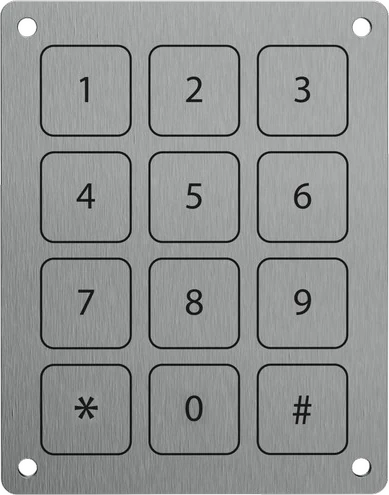 PIN entry and access control: PK-12. 3 x 4, 12 keys, 16 x 16 mm keys, 73 x 93 mm front plate, matrix on 7 lines. The most common format for PIN entry and access control, also used in intercom and door entry, parking and ticketing, and self-service terminals. View the PK-12
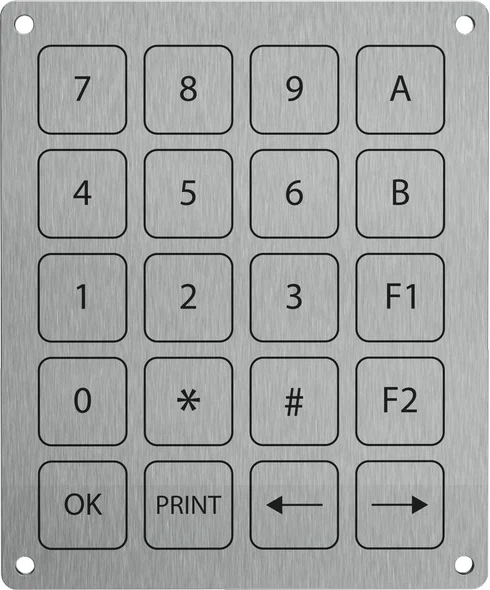 More than a PIN: PK-20. 5 x 4, 20 keys: 0 to 9, *, #, A, B, F1, F2, OK, PRINT and two arrow keys. 92 x 111 mm front plate, matrix on 9 lines or common bus. Used in parking pay stations, industrial terminals and self-service equipment. View the PK-20
 A specific layout: PK-Custom. Key count, rows and columns, dimensions, key size, spacing and marking are configurable. A standard 4 x 4 format is also available. Ask about a custom layout
 Adjustable sensitivity or digital communication: PT Plus. PT Plus variants add adjustable sensitivity, temperature compensation and digital communication to selected keypad formats. Explore PT Plus
Piezo keypad questions
Is a piezo keypad the same as a piezoelectric keypad?
Yes. Piezo keypad and piezoelectric keypad are names for the same component: a sealed keypad with no moving parts in which each key switches when its surface is pressed.
What output does a piezo keypad give?
Each key is normally open and momentary: a press closes its contact for a short pulse. On the RNC PK Series the pulse is 125 to 300 ms. The standard output is a matrix; the PK-20 is also available with a common bus, and Wiegand or RS-485 interfaces are available on request.
How do you wire a piezo keypad?
Like a standard matrix keypad: a key press connects its row line to its column line. The PK-12 uses 7 lines, the PK-20 9 lines. The PK Series switches 1 to 24 V at up to 200 mA.
Can a piezo keypad replace a membrane keypad?
Yes. The PK-12 and PK-20 datasheets list them as direct replacements for mechanical or membrane keypads. Check the mounting drawing against your cutout and read the key on the press, because a piezo key gives a pulse rather than a held contact.
How long does a piezo keypad last?
Each key of the RNC PK Series is rated for more than 50 million activations. With no moving parts there is no contact or dome to wear out.
Is a piezo keypad vandal resistant?
The PK Series is rated IK10 for impact, has no moving parts and is sealed to IP68 front and rear.
Does a piezo keypad work outdoors and in the cold?
The PK Series is sealed to IP68 front and rear and operates and stores from −40 °C to +85 °C.
Try one on your panel.
Samples of the PK-12 and PK-20 are available. Tell us the layout, the key count or the application and we will suggest the right configuration.